Exception Handling and Recovery
AI agents need the capacity to handle unforeseen situations, errors, and malfunctions to function dependably in varied real-world scenarios. Similar to human flexibility when confronted with unanticipated hurdles, intelligent agents must possess strong systems for detecting issues, enacting recovery procedures, or, at the very least, guaranteeing controlled failure. This fundamental requirement establishes the cornerstone for the Exception Handling and Recovery pattern.
The pattern focuses on creating exceptionally durable and resilient agents capable of preserving uninterrupted functionality and operational integrity despite facing a multitude of difficulties and anomalies. It highlights the necessity of proactive preparation and reactive approaches to guarantee continuous functioning, even amidst challenges. This adaptability is crucial for ensuring agents can operate successfully within intricate and unpredictable settings, ultimately enhancing their general effectiveness and trustworthiness. The ability to handle unexpected occurrences ensures these AI systems are not only intelligent but also capable of maintaining stability and reliability, fostering greater confidence in their deployment and performance.
Building upon this, incorporating thorough monitoring and diagnostic tools further strengthens an agent’s capacity to identify and address issues swiftly, preventing potential disruptions and ensuring smoother operation in the face of evolving conditions. These advanced systems are vital for maintaining the integrity and efficiency of AI operations, reinforcing their capability to manage complexity and unpredictability. This pattern might be sometimes used in conjunction with reflection; for instance, if an initial attempt is unsuccessful and raises an exception, a reflective process can analyze the failure and retry the task with a refined approach, such as an improved prompt, to see if the error can be resolved.
Exception Handling and Recovery Pattern Overview
The Exception Handling and Recovery pattern addresses the need for AI agents to manage operational failures. This pattern involves anticipating potential issues, such as tool errors or service unavailability, and developing strategies to mitigate them. These strategies may include error logging, retries, fallbacks, graceful degradation, and notifications. Additionally, the pattern emphasizes recovery mechanisms like state rollback, diagnosis, self-correction, and escalation, to restore agents to stable operation. Implementing this pattern enhances the reliability and robustness of AI agents, allowing them to function in unpredictable environments. Examples of practical applications include chatbots managing database errors, trading bots handling financial errors, and smart home agents addressing device malfunctions. The pattern ensures that agents can continue to operate effectively despite encountering complexities and failures.
Key components of exception handling and recovery for AI agents are:
Error Detection: This involves meticulously identifying operational issues as they arise. This could manifest as invalid or malformed tool outputs, specific API errors such as 404 (Not Found) or 500 (Internal Server Error) codes, unusually long response times from services or APIs, or incoherent and nonsensical responses that deviate from expected formats. Additionally, monitoring by other agents or specialized monitoring systems might be implemented for more proactive anomaly detection, enabling the system to catch potential issues before they escalate.
Error Handling: Once an error is detected, a carefully thought-out response plan is essential. This includes recording error details meticulously in logs for later debugging and analysis (logging). Retrying the action or request, sometimes with slightly adjusted parameters, may be a viable strategy, especially for transient errors (retries). Utilizing alternative strategies or methods (fallbacks) can ensure that some functionality is maintained. Where complete recovery is not immediately possible, the agent can maintain partial functionality to provide at least some value (graceful degradation). Finally, alerting human operators or other agents might be crucial for situations that require human intervention or collaboration (notification).
Recovery: This stage is about restoring the agent or system to a stable and operational state after an error. It could involve reversing recent changes or transactions to undo the effects of the error (state rollback). A thorough investigation into the cause of the error is vital for preventing recurrence. Adjusting the agent's plan, logic, or parameters through a self-correction mechanism or replanning process may be needed to avoid the same error in the future. In complex or severe cases, delegating the issue to a human operator or a higher-level system (escalation) might be the best course of action.
Implementation of this robust exception handling and recovery pattern can transform AI agents from fragile and unreliable systems into robust, dependable components capable of operating effectively and resiliently in challenging and highly unpredictable environments. This ensures that the agents maintain functionality, minimize downtime, and provide a seamless and reliable experience even when faced with unexpected issues.

Practical Applications & Use Cases
Exception Handling and Recovery is critical for any agent deployed in a real-world scenario where perfect conditions cannot be guaranteed.
Customer Service Chatbots: If a chatbot tries to access a customer database and the database is temporarily down, it shouldn't crash. Instead, it should detect the API error, inform the user about the temporary issue, perhaps suggest trying again later, or escalate the query to a human agent.
Automated Financial Trading: A trading bot attempting to execute a trade might encounter an "insufficient funds" error or a "market closed" error. It needs to handle these exceptions by logging the error, not repeatedly trying the same invalid trade, and potentially notifying the user or adjusting its strategy.
Smart Home Automation: An agent controlling smart lights might fail to turn on a light due to a network issue or a device malfunction. It should detect this failure, perhaps retry, and if still unsuccessful, notify the user that the light could not be turned on and suggest manual intervention.
Data Processing Agents: An agent tasked with processing a batch of documents might encounter a corrupted file. It should skip the corrupted file, log the error, continue processing other files, and report the skipped files at the end rather than halting the entire process.
Web Scraping Agents: When a web scraping agent encounters a CAPTCHA, a changed website structure, or a server error (e.g., 404 Not Found, 503 Service Unavailable), it needs to handle these gracefully. This could involve pausing, using a proxy, or reporting the specific URL that failed.
Robotics and Manufacturing: A robotic arm performing an assembly task might fail to pick up a component due to misalignment. It needs to detect this failure (e.g., via sensor feedback), attempt to readjust, retry the pickup, and if persistent, alert a human operator or switch to a different component.
This pattern is fundamental for building agents that are not only intelligent but also reliable, resilient, and user-friendly in the face of real-world complexities.
At a Glance
What: AI agents operating in real-world environments inevitably encounter unforeseen situations, errors, and system malfunctions. These disruptions can range from tool failures and network issues to invalid data, threatening the agent's ability to complete its tasks. Without a structured way to manage these problems, agents can be fragile, unreliable, and prone to complete failure when faced with unexpected hurdles. This unreliability makes it difficult to deploy them in critical or complex applications where consistent performance is essential.
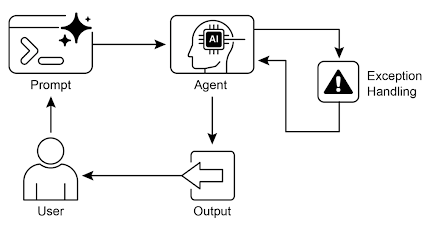
Why: The Exception Handling and Recovery pattern provides a standardized solution for building robust and resilient AI agents. It equips them with the agentic capability to anticipate, manage, and recover from operational failures. The pattern involves proactive error detection, such as monitoring tool outputs and API responses, and reactive handling strategies like logging for diagnostics, retrying transient failures, or using fallback mechanisms. For more severe issues, it defines recovery protocols, including reverting to a stable state, self-correction by adjusting its plan, or escalating the problem to a human operator. This systematic approach ensures agents can maintain operational integrity, learn from failures, and function dependably in unpredictable settings.
Rule of thumb: Use this pattern for any AI agent deployed in a dynamic, real-world environment where system failures, tool errors, network issues, or unpredictable inputs are possible and operational reliability is a key requirement.
Visual summary
Key Takeaways
Essential points to remember:
Exception Handling and Recovery is essential for building robust and reliable AI agents.
It involves detecting errors, handling them gracefully, and implementing strategies to recover.
Error detection can involve validating tool outputs, checking API error codes, and using timeouts.
Handling strategies include logging, retries, fallbacks, graceful degradation, and notifications.
Recovery focuses on restoring stable operation through diagnosis, self-correction, or escalation.
This pattern ensures agents can operate effectively even in unpredictable real-world environments.
Conclusion
we explored the Exception Handling and Recovery pattern, which is essential for developing robust and dependable AI agents. This pattern addresses how AI agents can identify and manage unexpected issues, implement appropriate responses, and recover to a stable operational state. We discussed various aspects of this pattern, including the detection of errors, the handling of these errors through mechanisms such as logging, retries, and fallbacks, and the strategies used to restore the agent or system to proper function. Practical applications of the Exception Handling and Recovery pattern are illustrated across several domains to demonstrate its relevance in handling real-world complexities and potential failures. These applications show how equipping AI agents with exception handling capabilities contributes to their reliability and adaptability in dynamic environments.
References
McConnell, S. (2004). Code Complete (2nd ed.). Microsoft Press.
Shi, Y., Pei, H., Feng, L., Zhang, Y., & Yao, D. (2024). Towards Fault Tolerance in Multi-Agent Reinforcement Learning. arXiv preprint
O'Neill, V. (2022). Improving Fault Tolerance and Reliability of Heterogeneous Multi-Agent IoT Systems Using Intelligence Transfer. Electronics, 11(17), 2724.