Model Context Protocol (MCP)
To enable LLMs to function effectively as agents, their capabilities must extend beyond text generation. Interaction with the external environment is necessary, including access to current data, utilization of external software, and execution of specific operational tasks. The Model Context Protocol (MCP) addresses this need by providing a standardized interface for LLMs to interface with external resources. This protocol serves as a key mechanism to facilitate consistent and predictable integration.
MCP Pattern Overview
Imagine a universal adapter that allows any LLM to plug into any external system, database, or tool without a custom integration for each one. That's essentially what the Model Context Protocol (MCP) is. It's an open standard designed to standardize how LLMs like Gemini, OpenAI's GPT models, Mixtral and Claude communicate with external applications, data sources, and tools. Think of it as a universal connection mechanism that simplifies how LLMs obtain context, execute actions, and interact with various systems.
MCP operates on a client-server architecture. It defines how different elements—data (referred to as resources), interactive templates (which are essentially prompts), and actionable functions (known as tools)—are exposed by an MCP server. These are then consumed by an MCP client, which could be an LLM host application or an AI agent itself. This standardized approach dramatically reduces the complexity of integrating LLMs into diverse operational environments.
However, MCP is a contract for an "agentic interface," and its effectiveness depends heavily on the design of the underlying APIs it exposes. There is a risk that developers simply wrap pre-existing, legacy APIs without modification, which can be suboptimal for an agent. For example, if a ticketixng system's API only allows retrieving full ticket details one by one, an agent asked to summarize high-priority tickets will be slow and inaccurate at high volumes. To be truly effective, the underlying API should be improved with deterministic features like filtering and sorting to help the non-deterministic agent work efficiently. This highlights that agents do not magically replace deterministic workflows; they often require stronger deterministic support to succeed.
Furthermore, MCP can wrap an API whose input or output is still not inherently understandable by the agent. An API is only useful if its data format is agent-friendly, a guarantee that MCP itself does not enforce. For instance, creating an MCP server for a document store that returns files as PDFs is mostly useless if the consuming agent cannot parse PDF content. The better approach would be to first create an API that returns a textual version of the document, such as Markdown, which the agent can actually read and process. This demonstrates that developers must consider not just the connection, but the nature of the data being exchanged to ensure true compatibility.
MCP vs. Tool Function Calling
The Model Context Protocol (MCP) and tool function calling are distinct mechanisms that enable Large Language Models (LLMs) to interact with external capabilities (including tools) and execute actions. While both serve to extend LLM capabilities beyond text generation, they differ in their approach and level of abstraction.
Tool function calling can be thought of as a direct request from an LLM to a specific, pre-defined tool or function. Note that in this context we use the words "tool" and "function” interchangeably. This interaction is characterized by a one-to-one communication model, where the LLM formats a request based on its understanding of a user's intent requiring external action. The application code then executes this request and returns the result to the LLM. This process is often proprietary and varies across different LLM providers.
In contrast, the Model Context Protocol (MCP) operates as a standardized interface for LLMs to discover, communicate with, and utilize external capabilities. It functions as an open protocol that facilitates interaction with a wide range of tools and systems, aiming to establish an ecosystem where any compliant tool can be accessed by any compliant LLM. This fosters interoperability, composability and reusability across different systems and implementations.
By adopting a federated model, we significantly improve interoperability and unlock the value of existing assets. This strategy allows us to bring disparate and legacy services into a modern ecosystem simply by wrapping them in an MCP-compliant interface. These services continue to operate independently, but can now be composed into new applications and workflows, with their collaboration orchestrated by LLMs. This fosters agility and reusability without requiring costly rewrites of foundational systems.
Here's a breakdown of the fundamental distinctions between MCP and tool function calling:
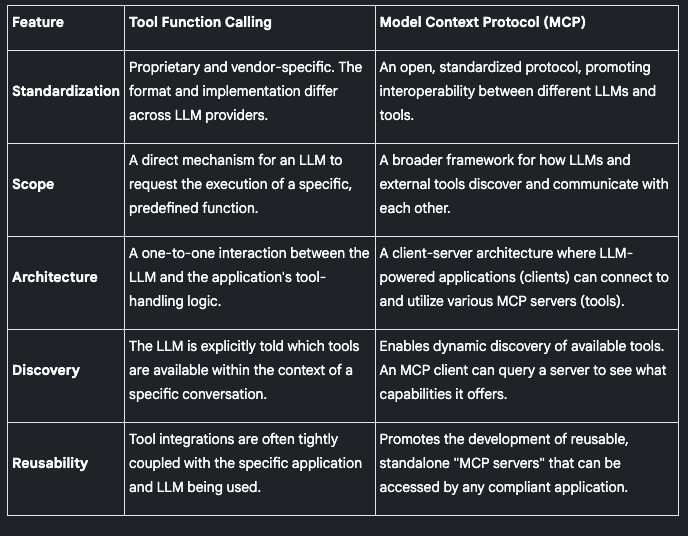
Think of tool function calling as giving an AI a specific set of custom-built tools, like a particular wrench and screwdriver. This is efficient for a workshop with a fixed set of tasks. MCP (Model Context Protocol), on the other hand, is like creating a universal, standardized power outlet system. It doesn't provide the tools itself, but it allows any compliant tool from any manufacturer to plug in and work, enabling a dynamic and ever-expanding workshop.
In short, function calling provides direct access to a few specific functions, while MCP is the standardized communication framework that lets LLMs discover and use a vast range of external resources. For simple applications, specific tools are enough; for complex, interconnected AI systems that need to adapt, a universal standard like MCP is essential.
Additional considerations for MCP
While MCP presents a powerful framework, a thorough evaluation requires considering several crucial aspects that influence its suitability for a given use case. Let's see some aspects in more details:
Tool vs. Resource vs. Prompt: It's important to understand the specific roles of these components. A resource is static data (e.g., a PDF file, a database record). A tool is an executable function that performs an action (e.g., sending an email, querying an API). A prompt is a template that guides the LLM in how to interact with a resource or tool, ensuring the interaction is structured and effective.
Discoverability: A key advantage of MCP is that an MCP client can dynamically query a server to learn what tools and resources it offers. This "just-in-time" discovery mechanism is powerful for agents that need to adapt to new capabilities without being redeployed.
Security: Exposing tools and data via any protocol requires robust security measures. An MCP implementation must include authentication and authorization to control which clients can access which servers and what specific actions they are permitted to perform.
Implementation: While MCP is an open standard, its implementation can be complex. However, providers are beginning to simplify this process. For example, some model providers like Anthropic or FastMCP offer SDKs that abstract away much of the boilerplate code, making it easier for developers to create and connect MCP clients and servers.
Error Handling: A comprehensive error-handling strategy is critical. The protocol must define how errors (e.g., tool execution failure, unavailable server, invalid request) are communicated back to the LLM so it can understand the failure and potentially try an alternative approach.
Local vs. Remote Server: MCP servers can be deployed locally on the same machine as the agent or remotely on a different server. A local server might be chosen for speed and security with sensitive data, while a remote server architecture allows for shared, scalable access to common tools across an organization.
On-demand vs. Batch: MCP can support both on-demand, interactive sessions and larger-scale batch processing. The choice depends on the application, from a real-time conversational agent needing immediate tool access to a data analysis pipeline that processes records in batches.
Transportation Mechanism: The protocol also defines the underlying transport layers for communication. For local interactions, it uses JSON-RPC over STDIO (standard input/output) for efficient inter-process communication. For remote connections, it leverages web-friendly protocols like Streamable HTTP and Server-Sent Events (SSE) to enable persistent and efficient client-server communication.
The Model Context Protocol operates on a clear client-server model that standardizes the flow of information and actions. Understanding the interaction between the core components is key to grasping how MCP enables advanced agentic behavior.
The primary components are:
Large Language Model (LLM): The core intelligence. It processes user requests, formulates plans, and decides when it needs to access external information or perform an action.
MCP Client: This is an application or wrapper around the LLM. It acts as the intermediary, translating the LLM's intent into a formal request that conforms to the MCP standard. It is responsible for discovering, connecting to, and communicating with MCP Servers.
MCP Server: This is the gateway to the external world. It exposes a set of tools, resources, and prompts to any authorized MCP Client. Each server is typically responsible for a specific domain, such as a connection to a company's internal database, an email service, or a public API.
Optional Third-Party (3P) Service: This represents the actual external tool, application, or data source that the MCP Server manages and exposes. It is the ultimate endpoint that performs the requested action, such as querying a proprietary database, interacting with a SaaS platform, or calling a public weather API.
The interaction flows as follows:
Discovery: The MCP Client, on behalf of the LLM, queries an MCP Server to ask what capabilities it offers. The server responds with a manifest listing its available tools (e.g., send_email), resources (e.g., customer_database), and prompts.
Request Formulation: The LLM determines it needs to use one of the discovered tools. For instance, it decides to send an email. It formulates a request, specifying the tool to use (send_email) and the necessary parameters (recipient, subject, body).
Client Communication: The MCP Client takes the LLM's formulated request and sends it as a standardized call to the appropriate MCP Server.
Server Execution: The MCP Server receives the request. It authenticates the client, validates the request, and then executes the specified action by interfacing with the underlying software (e.g., calling the send() function of an email API).
Response and Context Update: After execution, the MCP Server sends a standardized response back to the MCP Client. This response indicates whether the action was successful and includes any relevant output (e.g., a confirmation ID for the sent email). The client then passes this result back to the LLM, updating its context and enabling it to proceed with the next step of its task.
Practical Applications & Use Cases
The Model Context Protocol significantly broadens the capabilities of AI agents and LLMs, making them more versatile and powerful in real-world applications. Here are eight key use cases for MCP:
1. Database Integration: MCP allows LLMs and agents to seamlessly access and interact with structured data in databases. For instance, using the MCP Toolbox for Databases, an agent can query BigQuery datasets to retrieve real-time information, generate reports, or update records, all driven by natural language commands.
2. Generative Media Orchestration: MCP enables agents to integrate with advanced generative media services. Through MCP Tools for Genmedia Services, an agent can orchestrate workflows involving Google's Imagen for image generation, Google's Veo for video creation, Google's Chirp 3 HD for realistic voices, or Google's Lyria for music composition, allowing for dynamic content creation within AI applications.
3. External API Interaction: MCP provides a standardized way for LLMs to call and receive responses from any external API. This means an agent can fetch live weather data, pull stock prices, send emails, or interact with CRM systems, extending its capabilities far beyond its core language model.
4. Reasoning-Based Information Extraction: Leveraging an LLM's strong reasoning skills, MCP facilitates effective, query-dependent information extraction that surpasses conventional search and retrieval systems. Instead of a traditional search tool returning an entire document, an agent can analyze the text and extract the precise clause, figure, or statement that directly answers a user's complex question.
5. Custom Tool Development: Developers can build custom tools and expose them via an MCP server (e.g., using FastMCP). This allows specialized internal functions or proprietary systems to be made available to LLMs and other agents in a standardized, easily consumable format, without needing to modify the LLM directly.
6. Standardized LLM-to-Application Communication: MCP ensures a consistent communication layer between LLMs and the applications they interact with. This reduces integration overhead, promotes interoperability between different LLM providers and host applications, and simplifies the development of complex agentic systems.
7. Complex Workflow Orchestration: By combining various MCP-exposed tools and data sources, agents can orchestrate highly complex, multi-step workflows. An agent could, for example, retrieve customer data from a database, generate a personalized marketing image, draft a tailored email, and then send it, all by interacting with different MCP services.
8. IoT Device Control: MCP can facilitate LLM interaction with Internet of Things (IoT) devices. An agent could use MCP to send commands to smart home appliances, industrial sensors, or robotics, enabling natural language control and automation of physical systems.
9. Financial Services Automation: In financial services, MCP could enable LLMs to interact with various financial data sources, trading platforms, or compliance systems. An agent might analyze market data, execute trades, generate personalized financial advice, or automate regulatory reporting, all while maintaining secure and standardized communication.
The Model Context Protocol (MCP) facilitates agent access to real-time information by enabling connections to databases, APIs, and web resources. This protocol further allows agents to perform actions, such as sending emails, updating records, or controlling physical devices. Agents can also execute complex tasks by integrating data from various sources, processing this information, and then initiating actions across different platforms. Additionally, MCP supports integration with media generation tools, facilitating the use of image, video, and audio generation within AI applications.
At a Glance
What: To function as effective agents, LLMs must move beyond simple text generation. They require the ability to interact with the external environment to access current data and utilize external software. Without a standardized communication method, each integration between an LLM and an external tool or data source becomes a custom, complex, and non-reusable effort. This ad-hoc approach hinders scalability and makes building complex, interconnected AI systems difficult and inefficient.
Why: The Model Context Protocol (MCP) offers a standardized solution by acting as a universal interface between LLMs and external systems. It establishes an open, standardized protocol that defines how external capabilities are discovered and used. Operating on a client-server model, MCP allows servers to expose tools, data resources, and interactive prompts to any compliant client. LLM-powered applications act as these clients, dynamically discovering and interacting with available resources in a predictable manner. This standardized approach fosters an ecosystem of interoperable and reusable components, dramatically simplifying the development of complex agentic workflows.
Rule of thumb: Use the Model Context Protocol (MCP) when building complex, scalable, or enterprise-grade agentic systems that need to interact with a diverse and evolving set of external tools, data sources, and APIs. It is ideal when interoperability between different LLMs and tools is a priority, and when agents require the ability to dynamically discover new capabilities without being redeployed. For simpler applications with a fixed and limited number of predefined functions, direct tool function calling may be sufficient.
Visual summary

Key Takeaways
-
The Model Context Protocol (MCP) is an open standard facilitating standardized communication between Large Language Models (LLMs) and external applications, data sources, and tools.
-
It employs a client-server architecture, defining the methods for exposing and consuming resources, prompts, and tools.
-
The Agent Development Kit (ADK) supports both utilizing existing MCP servers and exposing ADK tools via an MCP server.
-
MCP Toolbox for Databases enables agents to access database data, with integrated ADK support.
-
FastMCP simplifies the development and management of MCP servers, particularly for exposing tools implemented in Python.
-
MCP Tools for Genmedia Services allows agents to integrate with Google Cloud's generative media capabilities (Imagen, Veo, Chirp 3 HD, Lyria).
-
MCP enables LLMs and agents to interact with real-world systems, access dynamic information, and perform actions beyond text generation.
Conclusion
The Model Context Protocol (MCP) is an open standard that facilitates communication between Large Language Models (LLMs) and external systems. It employs a client-server architecture, enabling LLMs to access resources, utilize prompts, and execute actions through standardized tools. MCP allows LLMs to interact with databases, manage generative media workflows, control IoT devices, and automate financial services. Practical examples demonstrate setting up agents to communicate with MCP servers, including filesystem servers and servers built with FastMCP, illustrating its integration with the Agent Development Kit (ADK). MCP is a key component for developing interactive AI agents that extend beyond basic language capabilities.