Multi-Agent Collaboration
While a monolithic agent architecture can be effective for well-defined problems, its capabilities are often constrained when faced with complex, multi-domain tasks. The Multi-Agent Collaboration pattern addresses these limitations by structuring a system as a cooperative ensemble of distinct, specialized agents. This approach is predicated on the principle of task decomposition, where a high-level objective is broken down into discrete sub-problems. Each sub-problem is then assigned to an agent possessing the specific tools, data access, or reasoning capabilities best suited for that task.
For example, a complex research query might be decomposed and assigned to a Research Agent for information retrieval, a Data Analysis Agent for statistical processing, and a Synthesis Agent for generating the final report. The efficacy of such a system is not merely due to the division of labor but is critically dependent on the mechanisms for inter-agent communication. This requires a standardized communication protocol and a shared ontology, allowing agents to exchange data, delegate sub-tasks, and coordinate their actions to ensure the final output is coherent.
This distributed architecture offers several advantages, including enhanced modularity, scalability, and robustness, as the failure of a single agent does not necessarily cause a total system failure. The collaboration allows for a synergistic outcome where the collective performance of the multi-agent system surpasses the potential capabilities of any single agent within the ensemble.
Multi-Agent Collaboration Pattern Overview
The Multi-Agent Collaboration pattern involves designing systems where multiple independent or semi-independent agents work together to achieve a common goal. Each agent typically has a defined role, specific goals aligned with the overall objective, and potentially access to different tools or knowledge bases. The power of this pattern lies in the interaction and synergy between these agents.
Collaboration can take various forms:
Sequential Handoffs: One agent completes a task and passes its output to another agent for the next step in a pipeline (similar to the Planning pattern, but explicitly involving different agents).
Parallel Processing: Multiple agents work on different parts of a problem simultaneously, and their results are later combined.
Debate and Consensus: Agents with potentially different perspectives or information sources discuss a problem, evaluate options, and arrive at a consensus or a better-informed decision.
Hierarchical Structures: A manager agent might delegate tasks to worker agents and synthesize their results. Each agent can also handle relevant groups of tools, rather than a single agent handling all the tools.
Expert Teams: Agents with specialized knowledge in different domains (e.g., a researcher, a writer, an editor) collaborate to produce a complex output.
A multi-agent system fundamentally comprises the delineation of agent roles and responsibilities, the establishment of communication channels through which agents exchange information, and the formulation of a task flow or interaction protocol that directs their collaborative endeavors.
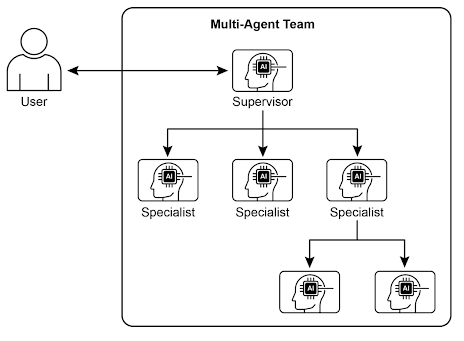
Frameworks such as Crew AI and Google ADK are engineered to facilitate this paradigm by providing structures for the specification of agents, tasks, and their interactive procedures. This approach is particularly effective for challenges necessitating a variety of specialized knowledge, encompassing multiple discrete phases, or leveraging the advantages of concurrent processing and the corroboration of information across agents.
Practical Applications & Use Cases
Multi-Agent Collaboration is a powerful pattern applicable across numerous domains:
Complex Research and Analysis: A team of agents could collaborate on a research project. One agent might specialize in searching academic databases, another in summarizing findings, a third in identifying trends, and a fourth in synthesizing the information into a report. This mirrors how a human research team might operate.
Software Development: Imagine agents collaborating on building software. One agent could be a requirements analyst, another a code generator, a third a tester, and a fourth a documentation writer. They could pass outputs between each other to build and verify components.
Creative Content Generation: Creating a marketing campaign could involve a market research agent, a copywriter agent, a graphic design agent (using image generation tools), and a social media scheduling agent, all working together.
Financial Analysis: A multi-agent system could analyze financial markets. Agents might specialize in fetching stock data, analyzing news sentiment, performing technical analysis, and generating investment recommendations.
Customer Support Escalation: A front-line support agent could handle initial queries, escalating complex issues to a specialist agent (e.g., a technical expert or a billing specialist) when needed, demonstrating a sequential handoff based on problem complexity.
Supply Chain Optimization: Agents could represent different nodes in a supply chain (suppliers, manufacturers, distributors) and collaborate to optimize inventory levels, logistics, and scheduling in response to changing demand or disruptions.
The capacity to delineate specialized agents and meticulously orchestrate their interrelationships empowers developers to construct systems exhibiting enhanced modularity, scalability, and the ability to address complexities that would prove insurmountable for a singular, integrated agent.
At a Glance
What: Complex problems often exceed the capabilities of a single, monolithic LLM-based agent. A solitary agent may lack the diverse, specialized skills or access to the specific tools needed to address all parts of a multifaceted task. This limitation creates a bottleneck, reducing the system's overall effectiveness and scalability. As a result, tackling sophisticated, multi-domain objectives becomes inefficient and can lead to incomplete or suboptimal outcomes.
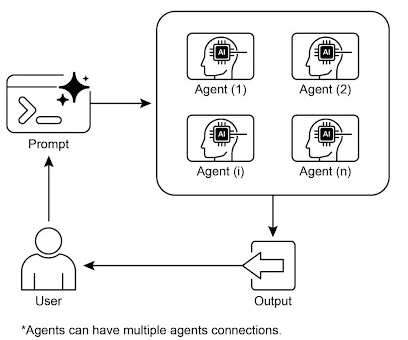
Why: The Multi-Agent Collaboration pattern offers a standardized solution by creating a system of multiple, cooperating agents. A complex problem is broken down into smaller, more manageable sub-problems. Each sub-problem is then assigned to a specialized agent with the precise tools and capabilities required to solve it. These agents work together through defined communication protocols and interaction models like sequential handoffs, parallel workstreams, or hierarchical delegation. This agentic, distributed approach creates a synergistic effect, allowing the group to achieve outcomes that would be impossible for any single agent.
Rule of thumb: Use this pattern when a task is too complex for a single agent and can be decomposed into distinct sub-tasks requiring specialized skills or tools. It is ideal for problems that benefit from diverse expertise, parallel processing, or a structured workflow with multiple stages, such as complex research and analysis, software development, or creative content generation.
Visual summary
Key Takeaways
Multi-Agent Collaboration involves multiple agents working together to achieve a common goal.
It leverages specialized roles, distributed tasks, and inter-agent communication. Collaboration can take forms like sequential handoffs, parallel processing, debate, or hierarchical structures.
MUlti agent is ideal for complex problems requiring diverse expertise or multiple distinct stages.
Conclusion
We explored the Multi-Agent Collaboration pattern, demonstrating the benefits of orchestrating multiple specialized agents within systems. Various collaboration models were examined, emphasizing the pattern's essential role in addressing complex, multifaceted problems across diverse domains. This understanding of agent collaboration naturally leads to an inquiry into their interactions with the external environment.