Parallelization in Agents.
Many complex agentic tasks involve multiple sub-tasks that can be executed simultaneously rather than one after another. This is where the Parallelization pattern becomes crucial.
Parallelization involves executing multiple components, such as LLM calls, tool usages, or even entire sub-agents, concurrently. Instead of waiting for one step to complete before starting the next, parallel execution allows independent tasks to run at the same time, significantly reducing the overall execution time for tasks that can be broken down into independent parts.
Consider an agent designed to research a topic and summarize its findings. A sequential approach might: 1. Search for Source A. 2. Summarize Source A. 3. Search for Source B. 4. Summarize Source B. 5. Synthesize a final answer from summaries A and B.
A parallel approach could instead: 1. Search for Source A and Search for Source B simultaneously. 2. Once both searches are complete, Summarize Source A and Summarize Source B simultaneously. 3. Synthesize a final answer from summaries A and B (this step is typically sequential, waiting for the parallel steps to finish).
The core idea is to identify parts of the workflow that do not depend on the output of other parts and execute them in parallel. This is particularly effective when dealing with external services (like APIs or databases) that have latency, as you can issue multiple requests concurrently.
Implementing parallelization often requires frameworks that support asynchronous execution or multi-threading/multi-processing. Modern agentic frameworks are designed with asynchronous operations in mind, allowing you to easily define steps that can run in parallel.
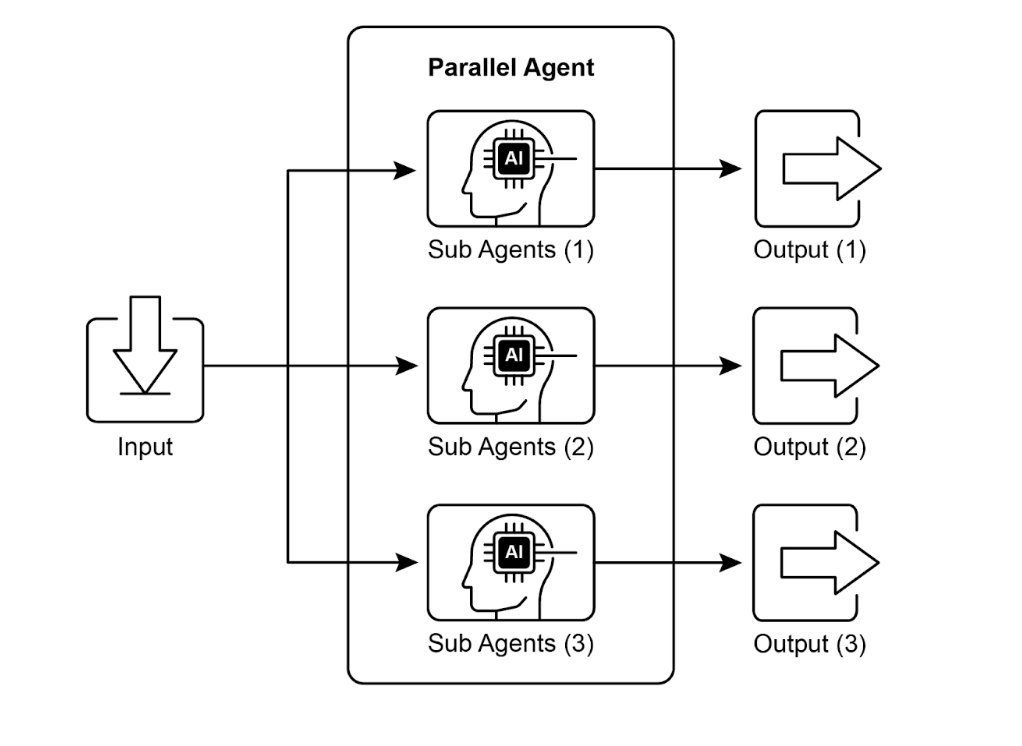
Frameworks like LangChain, LangGraph, and Google ADK provide mechanisms for parallel execution. In LangChain Expression Language (LCEL), you can achieve parallel execution by combining runnable objects using operators like | (for sequential) and by structuring your chains or graphs to have branches that execute concurrently.
LangGraph, with its graph structure, allows you to define multiple nodes that can be executed from a single state transition, effectively enabling parallel branches in the workflow. Google ADK provides robust, native mechanisms to facilitate and manage the parallel execution of agents, significantly enhancing the efficiency and scalability of complex, multi-agent systems. This inherent capability within the ADK framework allows developers to design and implement solutions where multiple agents can operate concurrently, rather than sequentially.
The Parallelization pattern is vital for improving the efficiency and responsiveness of agentic systems, especially when dealing with tasks that involve multiple independent lookups, computations, or interactions with external services. It's a key technique for optimizing the performance of complex agent workflows.
Practical Applications & Use Cases of Parallelization
Parallelization is a powerful pattern for optimizing agent performance across various applications:
1. Information Gathering and Research
Use Case: An agent researching a company.
Parallel Tasks:
- Search news articles
- Pull stock data
- Check social media mentions
- Query a company database
Benefit: Gathers a comprehensive view much faster than sequential lookups.
2. Data Processing and Analysis
Use Case: An agent analyzing customer feedback.
Parallel Tasks:
- Run sentiment analysis
- Extract keywords
- Categorize feedback
- Identify urgent issues
Benefit: Provides a multi-faceted analysis quickly.
3. Multi-API or Tool Interaction
Use Case: A travel planning agent.
Parallel Tasks:
- Check flight prices
- Search for hotel availability
- Look up local events
- Find restaurant recommendations
Benefit: Presents a complete travel plan faster.
4. Content Generation with Multiple Components
Use Case: An agent creating a marketing email.
Parallel Tasks:
- Generate a subject line
- Draft the email body
- Find a relevant image
- Create a call-to-action button text
Benefit: Assembles the final email more efficiently.
5. Validation and Verification
Use Case: An agent verifying user input.
Parallel Tasks:
- Check email format
- Validate phone number
- Verify address against a database
- Check for profanity
Benefit: Provides faster feedback on input validity.
6. Multi-Modal Processing
Use Case: An agent analyzing a social media post with text and an image.
Parallel Tasks:
- Analyze the text for sentiment and keywords
- Analyze the image for objects and scene description
Benefit: Integrates insights from different modalities more quickly.
7. A/B Testing or Multiple Options Generation
Use Case: An agent generating different creative text options.
Parallel Tasks:
- Generate three different headlines for an article simultaneously using slightly different prompts or models
Benefit: Allows for quick comparison and selection of the best option.
Conclusion
Parallelization is a fundamental optimization technique in agentic design, allowing developers to build more performant and responsive applications by leveraging concurrent execution for independent tasks.
At a Glance
What: Many agentic workflows involve multiple sub-tasks that must be completed to achieve a final goal. A purely sequential execution, where each task waits for the previous one to finish, is often inefficient and slow. This latency becomes a significant bottleneck when tasks depend on external I/O operations, such as calling different APIs or querying multiple databases. Without a mechanism for concurrent execution, the total processing time is the sum of all individual task durations, hindering the system's overall performance and responsiveness.
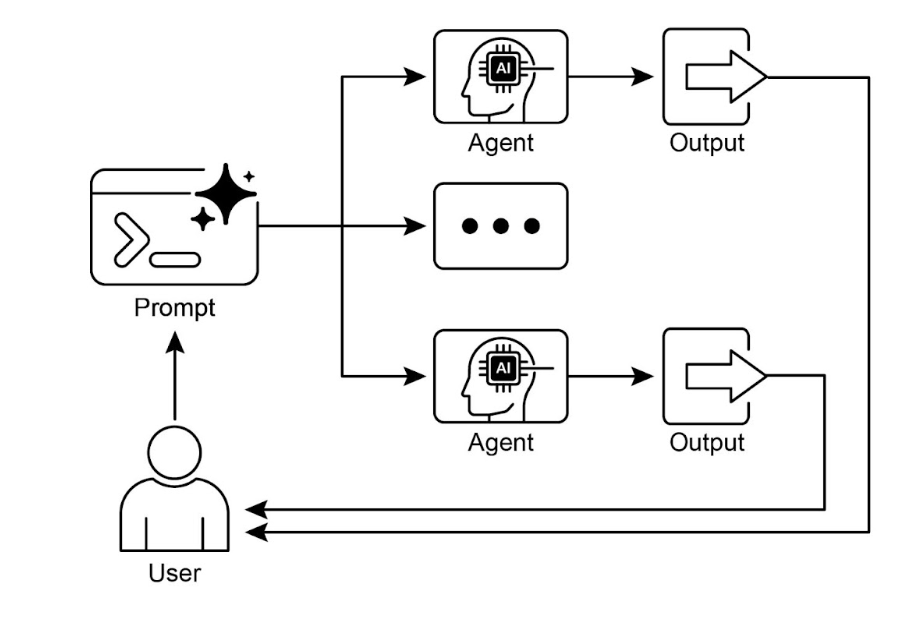
Why: The Parallelization pattern provides a standardized solution by enabling the simultaneous execution of independent tasks. It works by identifying components of a workflow, like tool usages or LLM calls, that do not rely on each other's immediate outputs. Agentic frameworks like LangChain and the Google ADK provide built-in constructs to define and manage these concurrent operations. For instance, a main process can invoke several sub-tasks that run in parallel and wait for all of them to complete before proceeding to the next step. By running these independent tasks at the same time rather than one after another, this pattern drastically reduces the total execution time.
Rule of thumb: Use this pattern when a workflow contains multiple independent operations that can run simultaneously, such as fetching data from several APIs, processing different chunks of data, or generating multiple pieces of content for later synthesis.
Visual summary
Key Takeaways
-
Parallelization is a pattern for executing independent tasks concurrently to improve efficiency.
-
It is particularly useful when tasks involve waiting for external resources, such as API calls.
-
The adoption of a concurrent or parallel architecture introduces substantial complexity and cost, impacting key development phases such as design, debugging, and system logging.
-
Frameworks like LangChain and Google ADK provide built-in support for defining and managing parallel execution.
-
In LangChain Expression Language (LCEL), RunnableParallel is a key construct for running multiple runnables side-by-side.
-
Google ADK can facilitate parallel execution through LLM-Driven Delegation, where a Coordinator agent's LLM identifies independent sub-tasks and triggers their concurrent handling by specialized sub-agents.
-
Parallelization helps reduce overall latency and makes agentic systems more responsive for complex tasks.
Conclusion
The parallelization pattern is a method for optimizing computational workflows by concurrently executing independent sub-tasks. This approach reduces overall latency, particularly in complex operations that involve multiple model inferences or calls to external services.
Frameworks provide distinct mechanisms for implementing this pattern. In LangChain, constructs like RunnableParallel are used to explicitly define and execute multiple processing chains simultaneously. In contrast, frameworks like the Google Agent Developer Kit (ADK) can achieve parallelization through multi-agent delegation, where a primary coordinator model assigns different sub-tasks to specialized agents that can operate concurrently.
By integrating parallel processing with sequential (chaining) and conditional (routing) control flows, it becomes possible to construct sophisticated, high-performance computational systems capable of efficiently managing diverse and complex tasks.
References
Here are some resources for further reading on the Parallelization pattern and related concepts: