Planning in Agents
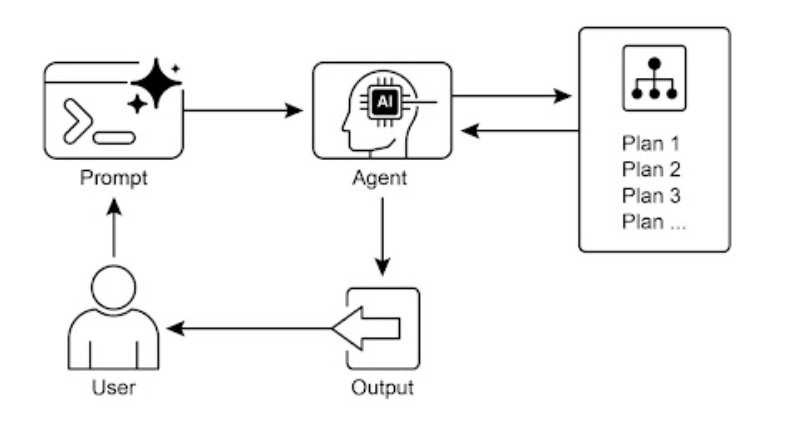
Intelligent behavior often involves more than just reacting to the immediate input. It requires foresight, breaking down complex tasks into smaller, manageable steps, and strategizing how to achieve a desired outcome. This is where the Planning pattern comes into play. At its core, planning is the ability for an agent or a system of agents to formulate a sequence of actions to move from an initial state towards a goal state.
it's helpful to think of a planning agent as a specialist to whom you delegate a complex goal. When you ask it to "organize a team offsite," you are defining the what—the objective and its constraints—but not the how. The agent's core task is to autonomously chart a course to that goal. It must first understand the initial state (e.g., budget, number of participants, desired dates) and the goal state (a successfully booked offsite) and then discover the optimal sequence of actions to connect them. The plan is not known in advance; it is created in response to the request.
A hallmark of this process is adaptability. An initial plan is merely a starting point, not a rigid script. The agent's real power is its ability to incorporate new information and steer the project around obstacles. For instance, if the preferred venue becomes unavailable or a chosen caterer is fully booked, a capable agent doesn't simply fail. It adapts. It registers the new constraint, re-evaluates its options, and formulates a new plan, perhaps by suggesting alternative venues or dates.
However, it is crucial to recognize the trade-off between flexibility and predictability. Dynamic planning is a specific tool, not a universal solution. When a problem's solution is already well-understood and repeatable, constraining the agent to a predetermined, fixed workflow is more effective. This approach limits the agent's autonomy to reduce uncertainty and the risk of unpredictable behavior, guaranteeing a reliable and consistent outcome. Therefore, the decision to use a planning agent versus a simple task-execution agent hinges on a single question: does the "how" need to be discovered, or is it already known?
Practical Applications & Use Cases
The Planning pattern is a core computational process in autonomous systems, enabling an agent to synthesize a sequence of actions to achieve a specified goal, particularly within dynamic or complex environments. This process transforms a high-level objective into a structured plan composed of discrete, executable steps.
In domains such as procedural task automation, planning is used to orchestrate complex workflows. For example, a business process like onboarding a new employee can be decomposed into a directed sequence of sub-tasks, such as creating system accounts, assigning training modules, and coordinating with different departments. The agent generates a plan to execute these steps in a logical order, invoking necessary tools or interacting with various systems to manage dependencies.
Within robotics and autonomous navigation, planning is fundamental for state-space traversal. A system, whether a physical robot or a virtual entity, must generate a path or sequence of actions to transition from an initial state to a goal state. This involves optimizing for metrics such as time or energy consumption while adhering to environmental constraints, like avoiding obstacles or following traffic regulations.
This pattern is also critical for structured information synthesis. When tasked with generating a complex output like a research report, an agent can formulate a plan that includes distinct phases for information gathering, data summarization, content structuring, and iterative refinement. Similarly, in customer support scenarios involving multi-step problem resolution, an agent can create and follow a systematic plan for diagnosis, solution implementation, and escalation.
In essence, the Planning pattern allows an agent to move beyond simple, reactive actions to goal-oriented behavior. It provides the logical framework necessary to solve problems that require a coherent sequence of interdependent operations.
At a Glance
What: Complex problems often cannot be solved with a single action and require foresight to achieve a desired outcome. Without a structured approach, an agentic system struggles to handle multifaceted requests that involve multiple steps and dependencies. This makes it difficult to break down high-level objectives into a manageable series of smaller, executable tasks. Consequently, the system fails to strategize effectively, leading to incomplete or incorrect results when faced with intricate goals.
Why: The Planning pattern offers a standardized solution by having an agentic system first create a coherent plan to address a goal. It involves decomposing a high-level objective into a sequence of smaller, actionable steps or sub-goals. This allows the system to manage complex workflows, orchestrate various tools, and handle dependencies in a logical order. LLMs are particularly well-suited for this, as they can generate plausible and effective plans based on their vast training data. This structured approach transforms a simple reactive agent into a strategic executor that can proactively work towards a complex objective and even adapt its plan if necessary.
Rule of thumb: Use this pattern when a user's request is too complex to be handled by a single action or tool. It is ideal for automating multi-step processes, such as generating a detailed research report, onboarding a new employee, or executing a competitive analysis. Apply the Planning pattern whenever a task requires a sequence of interdependent operations to reach a final, synthesized outcome
Key Takeaways
- Planning enables agents to break down complex goals into actionable, sequential steps.
- It is essential for handling multi-step tasks, workflow automation, and navigating complex environments.
- Large Language Models can perform planning by generating step-by-step approaches based on task descriptions.
- Explicitly prompting or designing tasks to require planning steps encourages this behavior in agent frameworks.
- Google Deep Research is an agent analyzing on our behalf sources obtained using Google Search as a tool. It reflects, plans, and executes
Conclusion
In conclusion, the Planning pattern is a foundational component that elevates agentic systems from simple reactive responders to strategic, goal-oriented executors. Modern large language models provide the core capability for this, autonomously decomposing high-level objectives into coherent, actionable steps. This pattern scales from straightforward, sequential task execution, as demonstrated by the CrewAI agent creating and following a writing plan, to more complex and dynamic systems. The Google DeepResearch agent exemplifies this advanced application, creating iterative research plans that adapt and evolve based on continuous information gathering. Ultimately, planning provides the essential bridge between human intent and automated execution for complex problems. By structuring a problem-solving approach, this pattern enables agents to manage intricate workflows and deliver comprehensive, synthesized results.